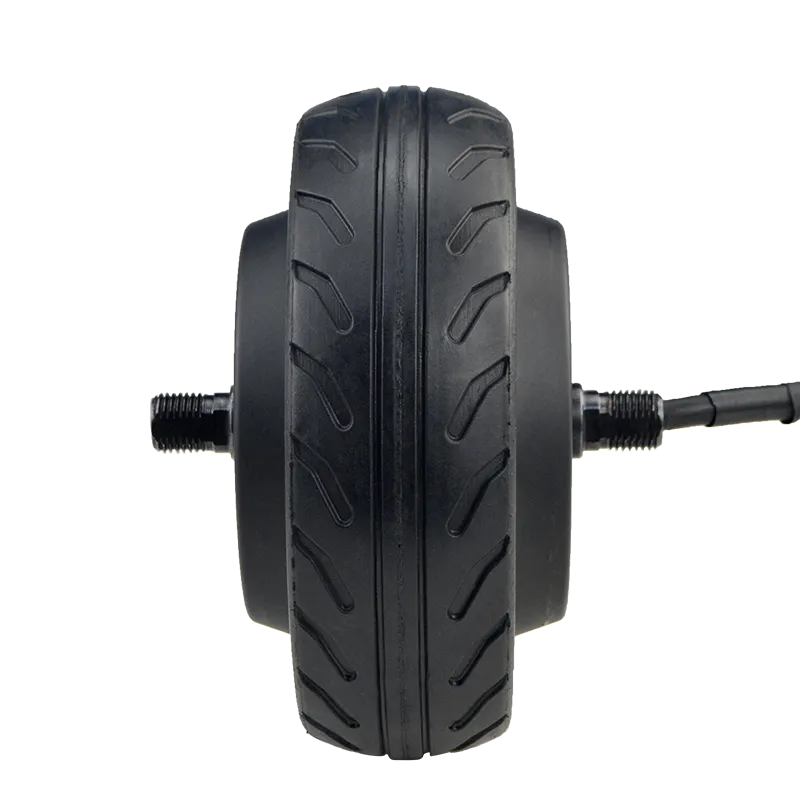
In automated systems subject to frequent start/stop cycles and heavy torque demands, transmission component reliability dictates machine uptime and lifecycle cost. Traditional single-side threaded shafts commonly used in compact hub motor assemblies show predictable failure modes: progressive eccentricity, axial play (shaft “walk” or axial runout), and accelerated wear of mating components. In practice, systems with more than 10,000 start/stop cycles annually or continuous peak torque loads above the motor’s rated torque see maintenance intervals shorten by 30–60% when single-thread connections are used without additional anti-backlash measures.
The dual-sided threaded shaft design—where threads engage with mating components on both ends or symmetrical arrangements—addresses these failure modes through force balancing and torsional stiffness enhancement. Key mechanical advantages include:
Engaging threads on both sides distributes axial preload and reaction forces symmetrically around the shaft midline. This reduces bending moments that cause eccentricity. Field engineering evaluations show dual-sided arrangements can reduce axial runout by up to 60–75% compared with single-sided threaded shafts under similar assembly tolerances.
With dual engagement points, the effective shear length resisting twist is greater, increasing torsional stiffness. Measured improvements in comparable 5-inch low-speed brushless DC hub motor prototypes indicate torsional stiffness gains in the order of 30–50%, which translates directly to improved positional stability and reduced micro-slip under dynamic loads.
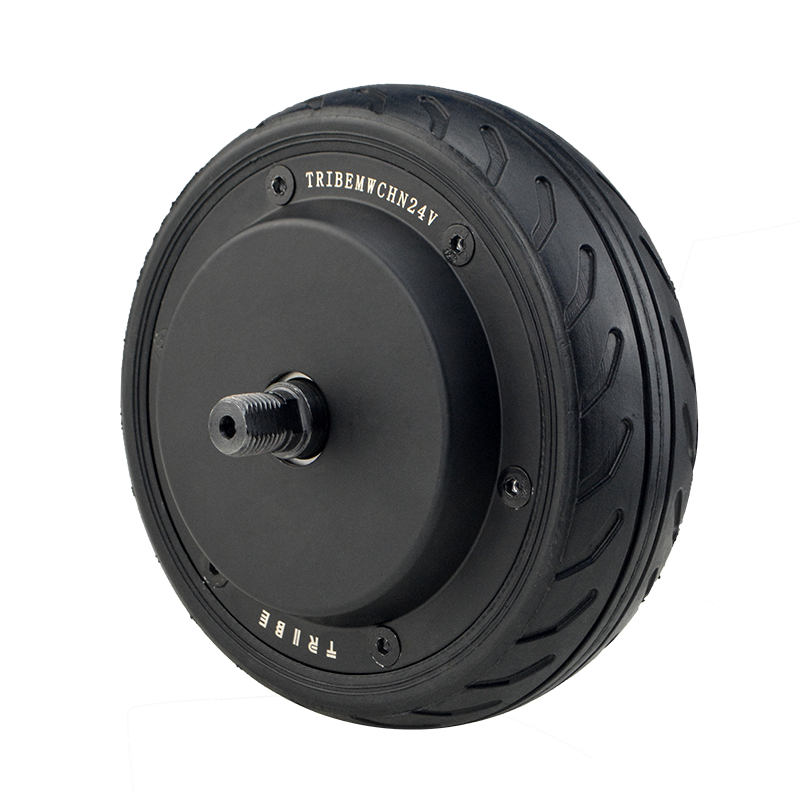
A superior mechanical design still requires correct installation. Below are actionable steps and measurable targets to guide system integrators and OEM assembly teams.
- Aim for concentricity of shaft to mating housing within 0.05–0.10 mm. Use dial indicators during assembly and soft-fixtured jigs for repeatability.
- Use temporary low-friction centering sleeves during final torqueing to avoid misalignment when preloads are applied.
- Preload should be applied symmetrically. Instead of relying on torque alone, use a calibrated axial preload tool or torque-turn method when possible.
- Monitor axial clearance after preload; target residual axial play under dynamic conditions should be below 0.05 mm for precision applications.
- Clean threads of machining residue and oils; microscopic debris can lead to uneven seating and preload loss.
- Specify surface treatments (e.g., controlled passivation, thin hard anodize, or PTFE-based dry film lubricants) that preserve friction consistency without promoting loosening.
Compact consumer devices such as electric luggage put stringent demands on quiet operation, compactness, and durability under repeated handling. The dual-sided threaded shaft is particularly suited to these use-cases for three reasons:
Engineer’s note: “On our end, switching to a dual-sided threaded shaft on a 5-inch hub motor prototype reduced vibration signatures by measurable margins and extended bearing life in endurance tests beyond our original target by roughly 40%. Assembly discipline—especially balanced preload—was the key enabler.” — Lead Mechanical Engineer, System Integrator
When specifying a dual-sided threaded shaft arrangement for a brushless DC hub motor or a high-torque application, include:
If you are specifying motors for intelligent baggage, precision robotics, or compact autonomous platforms, these engineering controls help bridge design intent and real-world durability.
Custom engineering support, testing protocols, and after-sales service available.
 110
|
110
|
 dual-axis threaded hub motor
hub motor durability
trailer hub motor for camping
hub motor selection guide
273
|
100mm open-slot hub motor
standardized open-slot design
wheel hub motor compatibility
industrial logistics upgrade
modular hub motor system
dual-axis threaded hub motor
hub motor durability
trailer hub motor for camping
hub motor selection guide
273
|
100mm open-slot hub motor
standardized open-slot design
wheel hub motor compatibility
industrial logistics upgrade
modular hub motor system